
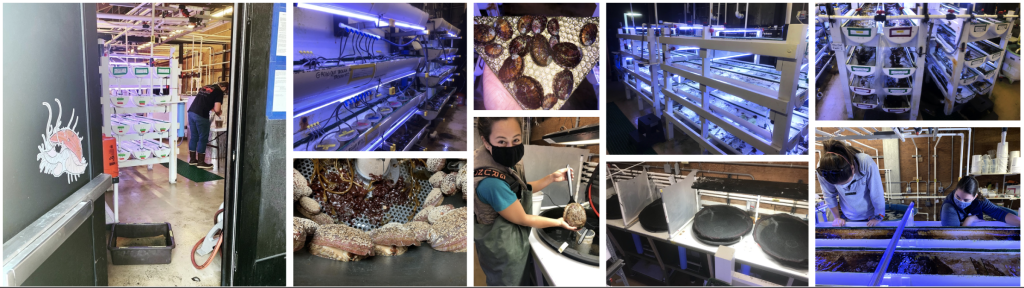
When former breeding program director Dr. Kristin Aquilino gives a tour of UC Davis Bodega Marine Laboratory’s (UCD-BML’s) White Abalone Culture Lab – a 600 square foot wet laboratory humming with the sounds of pumps and bubbling seawater – one of the first things she would tell you upon stepping inside is:
“There are more white abalone in this room than likely exist in the wild. This is both terrifying and also an incredible opportunity to save this species.”
In March 2011, this UC Davis Bodega Marine Laboratory became the hub of the White Abalone Captive Breeding Program. The program has seen tremendous growth and reached many recovery milestones in the exciting years that followed …
Saving White Abalone with former White Abalone Culture Lab director Dr. Kristin Aquilino
Humble Beginnings and a Lot of Luck
When the White Abalone Captive Breeding Program moved to the Bodega Marine Lab in 2011, no one had successfully spawned white abalone in almost a decade. The fate of the species hung in the balance as scientists explored possible methods for inducing spawning in this species.Then, on June 14th, 2012, a successful spawning occurred at UC Santa Barbara! Though only a few animals resulted from this spawn, this was a major milestone for the Captive Breeding Program! Production has only increased since then.

Of the 18 white abalone bathing in hydrogen peroxide solution on June 14th 2012, two females spawned very few eggs. A ripe female white abalone should spawn millions of eggs, but these two females released only ~300,000 eggs each. The one male that spawned only released a minuscule amount of sperm. In fact, its spawn was so fleeting, the scientists almost missed it! Though the sperm was scarce, it was enough to fertilize approximately half of the eggs that were spawned. About 20 animals from the spawn survived to be one year old. While only a few new white abalone resulted, successfully reproducing white abalone in captivity for the first time in nearly a decade was a huge leap forward for the recovery program. The subsequent years would focus on increasing the abundance and reliability of white abalone reproduction.
Optimizing Spawning & Culturing Techniques
A series of successful spawns in 2013 and 2014 helped scientists hone these spawning and culturing techniques and produced approximately 2,000 more white abalone. Many of them were either included in the first batch of captive white abalone to be placed in the wild (scroll down to “2019” for more on this milestone) or are now parents themselves, continuing to contribute to future generations of white abalone destined for the wild.
While production still lagged behind what was necessary for recovery, breakthroughs in increasing survival through early life history stages brought the Captive Breeding Program closer to the production goals necessary for supporting a successful Outplanting Program.
How to Spawn an Abalone
To spawn white abalone, each animal is placed into its own bucket filled with a mild hydrogen peroxide solution that triggers abalone to release eggs or sperm. Spawning attempts generally involve a team of people starting well before dawn or ending well after midnight, as the white abalone take 3-4 hours of soaking in their hydrogen peroxide “love potion” before they are in the mood for spawning. Animals are placed in individual containers or small groups, mixed with hydrogen peroxide, and watched closely.
With a lot of patience and luck, animals will begin to spawn after a few hours. Scientists then rinse the the hydrogen peroxide off the animals so that it doesn’t ruin the gametes (eggs and sperm).
They determine which genetic crosses will be made, and then mix eggs and sperm in specific ratio. This allows them to get a high fertilization rate without causing polyspermy, which is when there are too many sperm trying to get into the same egg, and can lead to the eggs bursting!
After the embryos are created, any extra sperm is rinsed away and the eggs are set in a monolayer in a hatching tray, which resembles a plastic bin.
Every so often, scientists check on the eggs to confirm that healthy development is occurring. First, we look for the first cell division, then the second, and so on. About 24 hours later, we can see a swimming trochophore larvae inside the egg, ready to hatch.
Once the larvae hatch, they are free-swimming for about 7 days. During this time they metamorphose into a veliger larvae, and can hide inside their developing shells. They develop eyespots. Scientists during this time transfer them every day to a fresh larval bucket, a special device that allows them to receive fresh seawater constantly but keeps these nearly invisible babies from flowing down the drain.
Changing larval buckets ensures that the larval cultures stay clean, preventing the build up of bacteria that could kill these vulnerable babies. After about 7 days, they begin to try and stick along the surface of the larval buckets. This is when scientists know that babies are ready for their first steps! (First crawl?)
The larvae are counted and scientists make decisions about which genetic crosses will go where, making sure not to settle too little larvae (because the tanks will then be overgrown with algae) nor too many larvae (because the tanks will be too crowded and they will run out of food) in each tank. Another chemical, GABA, is introduced and helps the larvae find the surfaces of the tanks where they can begin to crawl around and look for food. Speaking of food, the scientists are also culturing lots of different diatoms and other algae to feed to these microscopic babies.
The young animals will continue to graze on diatoms for about 4 months before getting their first taste of a larger red algae, called dulse (Devaleraea mollis).
A few months later, when they are more visible with the naked eye, we introduce giant kelp (Macrocystis pyrifera) and supplement their diets with other wild-harvested seaweeds.
The techniques didn’t evolve in vacuum – it took years of trial and error, building on work from other species, to get the recipe for success where it is today. And we still have room to improve!
 White Abalone Captive Breeding Program